Wasteful and Pointless
Every year, right on schedule, someone asks why the city still bothers with the parade. It’s wasteful, the argument goes, and pointless. I want to take that critique seriously, because it’s half right. It is wasteful. That is the point.

What a park strip taught me about the ROI of ritual.
The night before Provo’s Fourth of July parade, the route becomes a settlement. Canopies and camp chairs appear along the park strips, coolers get staked like territorial claims, and whole families bed down on public grass to guard a patch of curb they could have simply walked up to on any other day. My wife did this as a kid. She camped out with her grandmother, who was in her sixties at the time and apparently saw nothing strange about spending a July night on a strip of lawn to watch a parade she had seen fifty times before. My wife counts those nights among her favorite childhood memories and talks about “popping over to the Sev (7-Eleven) with money from grandma to buy treats.”
FIELD NOTE — The settlement appears at dusk on July 3rd and dissolves by mid-morning on the Fourth. Officially, it is seat-saving. In practice it is something closer to a citizenship ceremony.
Every year, right on schedule, someone online asks why the city still bothers. The parade is wasteful, the argument goes, and pointless. It closes streets, burns money and staff time, and produces nothing you could point to on a ledger. Grown adults sleeping on park strips to watch high school bands and vintage cars is presented as evidence that the whole thing has outlived whatever purpose it once had.
I want to take that critique seriously because it’s half right. It is wasteful. That’s the point.
The economics of throwing oranges.
Every February, the Italian town of Ivrea ships in hundreds of tons of oranges from the south of the country for the sole purpose of hurling them at people. Teams on foot pelt teams in horse-drawn carts, the streets run with pulp for three days, and then everyone cleans up and goes back to work. In Pamplona, Spain, the town releases bulls into the streets and thousands of otherwise sensible people run in front of them, some of whom get hurt doing it. Neither event would survive a cost-benefit analysis (although the tourism industry may have changed this in recent years). Both have survived for centuries.
COSTLY SIGNALING — A signal that is credible only because it is expensive to produce. See: three days of orange pulp; thirty-six hours on a park strip.
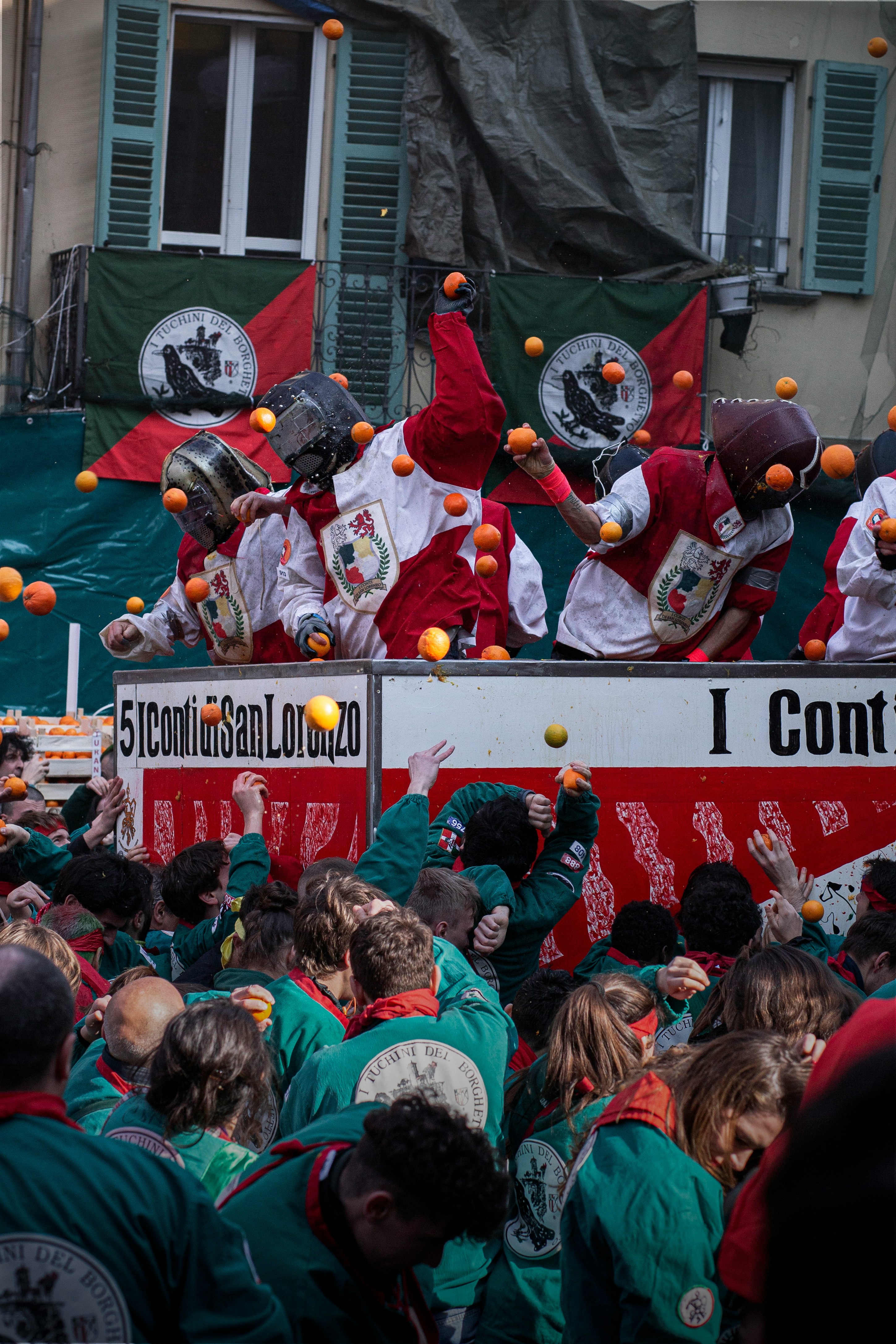
The Battle of the Oranges, Ivrea — three days of pulp, then everyone cleans up and goes back to work.
This is not an accident, and there’s a formal literature on why. Some anthropologists have described rituals like this as costly signaling. The idea, borrowed from biology, is that a signal is only credible if it’s expensive to produce. Anyone can say they’re committed to a community. Only someone who means it camps on a park strip for thirty-six hours. The anthropologist Richard Sosis tested this on nineteenth-century American communes and found that the religious communities demanding the most sacrifice from their members, in food taboos, dress codes, and surrendered property, were the ones that lasted longest. The demands weren’t a tax on the community: they were the mechanism producing it, because sacrifice is unfakeable, and unfakeable commitment is what lets people trust each other enough to actually cooperate.
We signal that something matters by investing in it against what appears to be obviously rational. And those investments are often the ones with the biggest, most durable returns. A library is not just a collection of books. It’s a temple to knowledge, where devotees gather reverently in veneration. Its marble columns are not a construction inefficiency. On the other hand, a home “library” is unlikely to provide that experience, except to the degree that the exact same mechanism (a whole room just for books!) is at play on a smaller scale for those living in the home.
Strip the waste out of the parade, make it convenient, let people drive up at 8:55 and leave at 10:15, and you would still have a parade. You would no longer have the thing the parade is for.
What the waste purchases.
Émile Durkheim had a name for that thing. Studying religious gatherings, he described what he called collective effervescence: the electric sense, produced only when people assemble in numbers and do something together, that you belong to something larger than your household. He considered it close to the foundation of social life itself. It doesn’t happen through screens and it can’t be delivered as a public service. It has to be generated in person, at some cost, by people who showed up.
COLLECTIVE EFFERVESCENCE — Durkheim’s term for the electricity of assembly: the felt sense of belonging to something larger than your household. Does not travel through screens. Cannot be delivered as a service.
I can report on what it purchases, because I married into the returns. My wife is one of six kids, and all six have stayed in the valley. Ask her why and the parade comes up unprompted, along with what I think of as the place-y-ness of it, the accumulated weight of rituals that made Provo feel less like a location and more like something you belong to. We bought our house partly because it sits on the parade route. This year we hosted the whole family for the Fourth, and I watched the next generation of cousins acquire, in one rambunctious morning, the kind of memory that ties people to a place for life.
I’ll make a personal confession, only because it’s ethnographically relevant. The city sets an official time before which you may not claim your spot. We claimed ours early, because the strips around us were already filling with canopies belonging to families from across the valley. Waiting for the legal hour would have meant watching the parade from somewhere other than the front of our own house. Note what’s happening here: the ritual’s pull is so strong as to draw people from miles away to sleep on a stranger’s park strip, against an ordinance that never stood a chance. What’s more, the ordinance seems more likely to become part of the ritual than to tame it—the risk of getting in trouble only increasing the cost and thus strengthening the glue. (Nothing like a bit of patriotic mischief to build local pride!)
And so for a whole night, before the parade ever starts, ordinary life gets suspended: kids up past bedtime, grandmothers holding territory like homesteaders, strangers in the next camp becoming neighbors because everyone is doing the same absurd thing. Anthropologists have terminology for all of this, but you don’t need to know the words to have felt it.
The secret ingredients.
There is a risk here that a discussion of parades, orange fights, and bull runs may give the faulty impression that municipalities can simply manufacture collective effervescence the way they might use road modifications to influence traffic patterns. Unfortunately, while policies and regulations do play a part, they’re far from sufficient. Our neighborhood’s annual Fourth of July block party illustrates this point beautifully.
A city can win every ROI argument and still become somewhere its own kids see no reason to stay.
The party is put on by a couple a few doors down. They pour real time and money into it, which matters but also isn’t enough—plenty of well-resourced events fall flat. What makes this one work is the irrational bits. At some point in the evening, the host, a man in his sixties who is somehow still the most physically fit person I know, disappears and re-emerges in a full body suit and helmet as a character called Rocket Man, and does jumps and tricks on a bike in front of the whole neighborhood. He usually has fireworks strapped to his back, but this year they weren’t allowed—so he opted for lasers. There are Rocket Man figurines. They get handed out to kids. None of this is necessary in any practical sense, and the unnecessariness is precisely what makes it an event instead of an activity. There’s an out-of-scale-ness to it, a spectacle exceeding all reasonable requirements, and that excess is what infuses the evening with meaning.
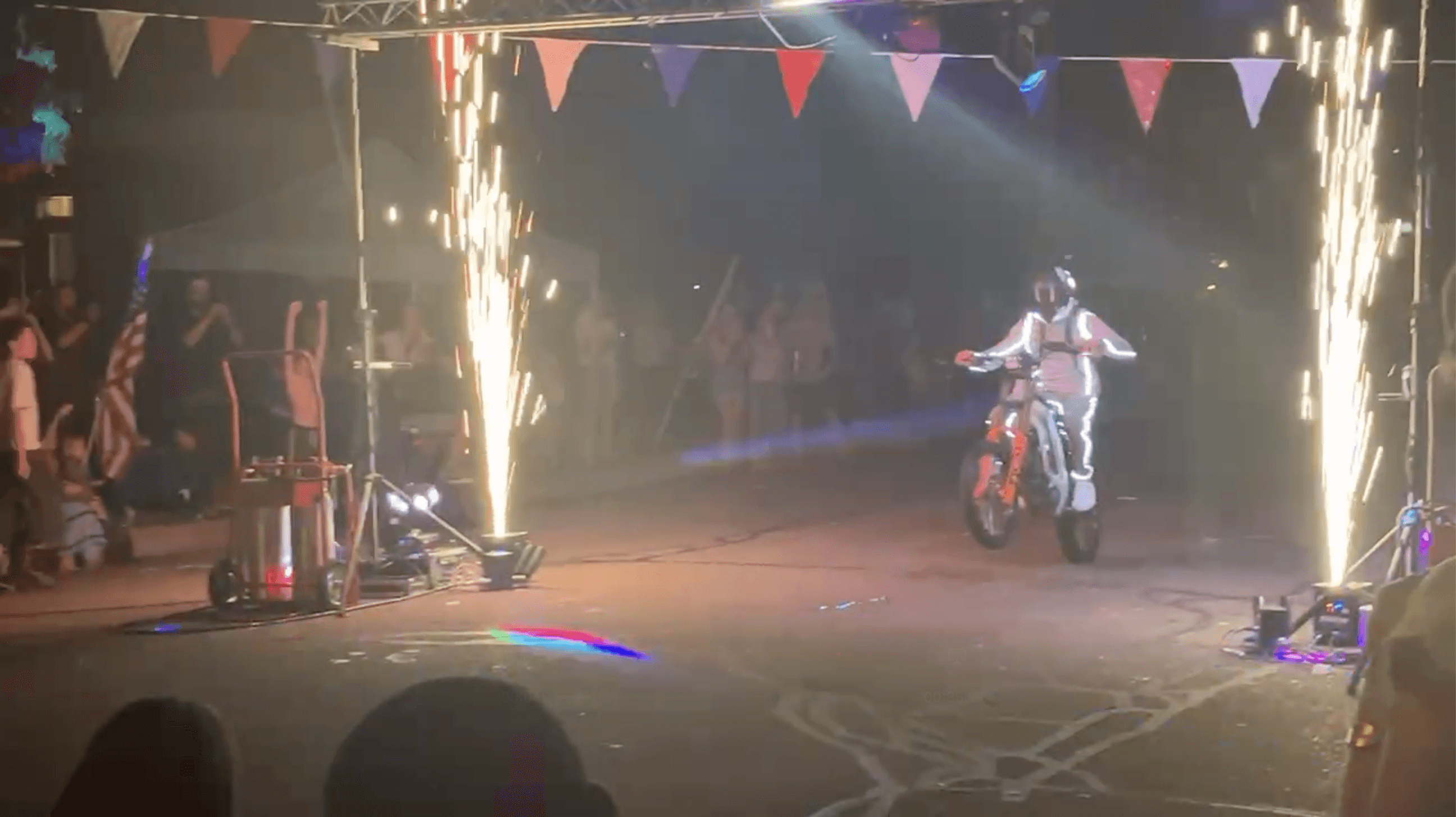
The block party — Rocket Man, lasers, and figurines for the kids.
But the deeper ingredient is this: it’s their party, and they give it away. They host it, fund at least most of it, and then decline to own it. Nobody is being marketed to and nothing is being recovered. It’s a gift, and gifts create relationships. Accepting the gift binds you to the giver and to everyone else who accepted it alongside you.
Frankly, there’s a lot more to say about how a thing like this actually works, and it deserves its own write-up. So for now, let’s talk about what a city can do to promote and preserve this kind of community-making collective effervescence.
What a city can do.
Provo is lucky to have a mayor who seems to understand the value of these gatherings intuitively. The temptation, though, is to treat the problem as regulatory: streamline the permits, waive the fees, and the block parties may bloom. Removing some obstacles is probably necessary (though some may actually be part of that costly signaling we talked about and should be left in place). Perhaps more importantly, regulations are largely beside the point. Clearly a neighborhood can throw a block party. The binding ingredients, the Rocket Men and the grandmothers camping out and the households willing to give a party away, can’t be permitted into existence. What a city can do is learn to see them. Recognize which rituals are load-bearing, protect them from the efficiency reflex, feed the people already carrying them, and resist the urge to formalize what’s working into a program.
I’ll share one final example only because it is a live case study. For years, a downtown rooftop concert series did quiet (figuratively speaking), uncounted work in making this city feel like itself. Then it lapsed, for roughly a mayoral generation, and though no line item recorded the loss, many people could feel that something had gone missing. It’s back now because someone decided it mattered, with or without a demonstrable return. That decision appears to have been correct, and the interesting thing is that nothing on a spreadsheet could have told you so. This is the uncomfortable math of the whole category: the places best at these rituals are the places with the deepest sense of who they are, and they have that sense because of the rituals. It’s a flywheel, which is why you can’t spin one up quickly, and why letting one stop costs more than any budget line shows.
The question underneath.
We’re fluent in one kind of question about how cities spend. Does the tax incentive pencil? What’s the return on the event budget? Does the parade pay for itself? Those questions have their place. But they quietly displace a prior question that determines far more about how life actually goes here: what kind of place is this going to be? A city can win every ROI argument and still become somewhere its own kids see no reason to stay.
The people camped on the park strips have an answer to the prior question, and they’re paying for it in the only currency that’s ever worked: skin in the game, a stiff back, thirty-six unnecessary hours. It looks wasteful and pointless. Look closer. It’s the most rational investment in town. ◆