Case Study: CoDesign in the Rainforest
The Problem
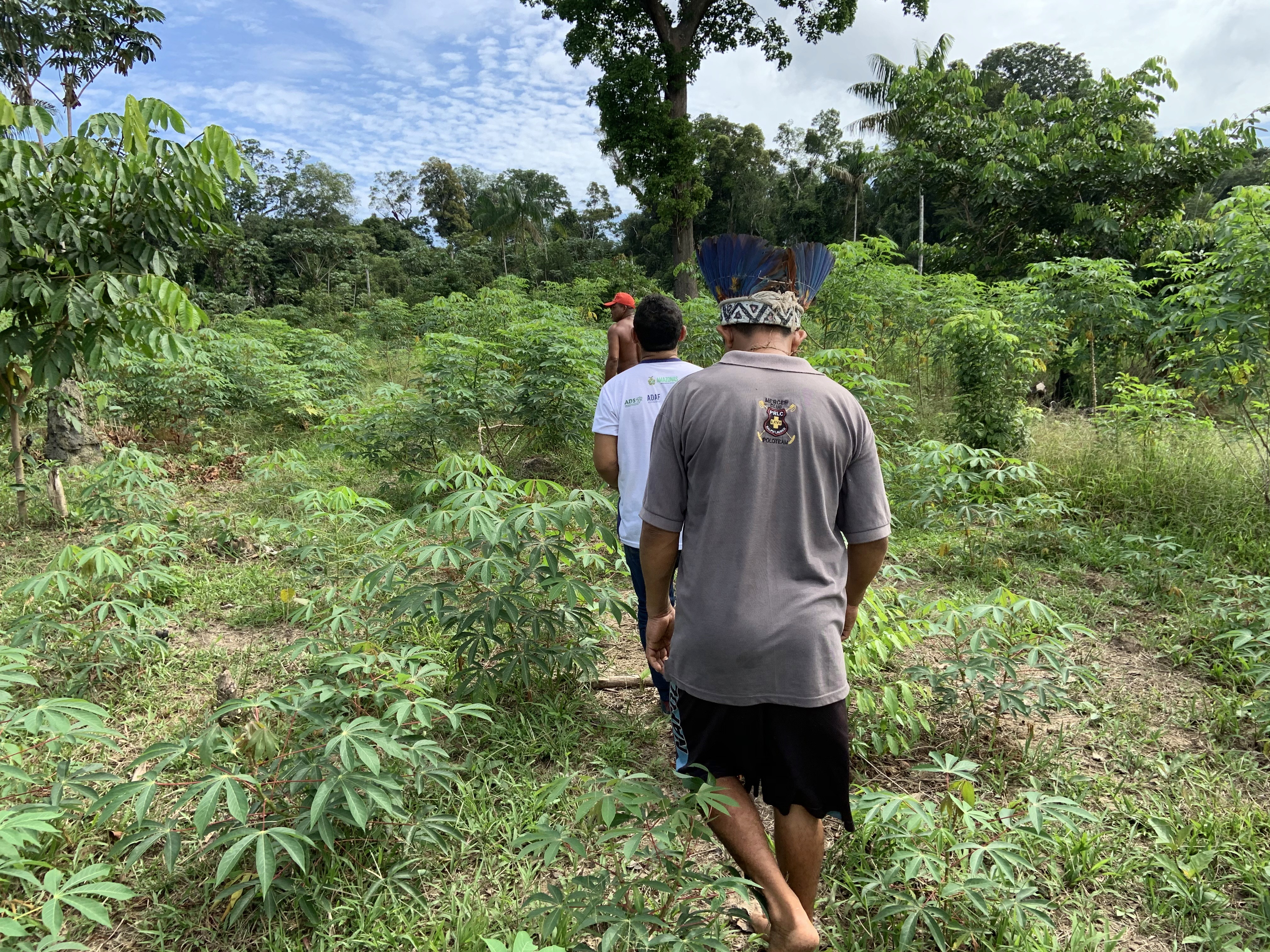
A team of mechanical engineers set out to design farming equipment for rural cassava farmers deep in the Brazilian Amazon. Positioned at the crossroads between design engineering and social impact, they recognized the risk that even a well-intentioned solution could fail to take root if it was not responsive to the local context. They saw this as an opportunity to innovate on not only the equipment itself, but on the process they used for generating mechanical solutions to social problems.
The team knew that a technically excellent machine wouldn't be enough. They had seen well-intentioned development projects around the world quickly relegated to the junk heap, and some that even had created negative downstream social impacts. Their goal was to create a solution that was economically viable, environmentally sound, and socially sustainable—what's often called the Triple Bottom Line. It would be something the farmers could feel ownership over and that made sense in its local context.
(This project was led by our founder prior to Peregrine's founding. Much of Peregrine's DNA can be traced back to this research.)
The Reframe
As we engaged with the project, a more fundamental challenge emerged: the stakeholders weren't simply bringing different preferences to the table. They were operating from entirely different logics—distinct frameworks for defining what success meant in the first place.
We identified three:
Engineering logic — oriented toward efficiency; success measured through quantifiable impact
Modernizing logic — oriented toward progress; success measured through financial well-being and time savings
Traditional logic — oriented toward conservation; success measured through closeness to tradition, family, and spiritual life
The critical dynamic was structural. Because the engineering and modernizing logics shared a preference for quantifiable outcomes, they naturally reinforced each other in decision-making. The traditional logic—which prioritized dimensions like cultural continuity, family cohesion, and spiritual connection—resisted easy translation into the metrics the engineers relied on. As a result, it was consistently underweighted.
This was compounded by an asymmetry of power. The engineers held the specialized skills without which the project could not proceed, giving them de facto authority over most major decisions. The arrangement wasn't adversarial—it was structural. But it meant the stakeholders the project was designed to serve had the least influence over its direction.
This is a pattern that recurs across stakeholder-driven initiatives: when collaborators operate from incompatible logics, the group whose logic is most easily quantified tends to dominate—not because their priorities are more important, but because they are easier to model.
The idea of "logics" comes from a branch of sociology and organizational theory called the "institutional logics perspective" (Thornton, Ocasio, and Lousbury 2012) which argues that the behavior or people and organizations is greatly shaped by the communities of organizations. These "institutional fields" have an internal logic that may often appear irrational from the outside but highly rational from the inside.
The distinction between logics may seem subtle, but in many cases it can be helpful to look at them like different religions. The rituals, ceremonies, and values of each are different. Power structures are different. Ways of explaining the world are different. It is hard to overstate the impact that the logics we inherit can have on the way we approach the world.
The Approach
We spent nearly two years embedded with the project's stakeholders—engineers, farmers, local politicians, and rural entrepreneurs—in a process many now call co-design (short for collaborative design).
Rather than treating research as a discrete phase that feeds into a separate design phase, we made the stakeholders themselves part of the design team. The goal was to let them shape the project from the inside rather than respond to it from the outside.
Our research design included:
Extended fieldwork and observation to understand how farming, family, and community life actually functioned—not just what people said they valued, but how those values showed up in daily practice
In-depth interviews across stakeholder groups to surface the distinct logics at work and understand where they aligned and where they conflicted
A structured co-design game we created specifically for this project, which allowed participants with vastly different backgrounds to discuss and rank potential impact areas in a shared framework—giving structure to inherently subjective terrain
This last piece was especially important. The game didn't eliminate subjectivity; it channeled it. It gave stakeholders a common language for expressing priorities that couldn't easily be reduced to numbers—things like tradition, autonomy, and spiritual connection—alongside priorities that could.
The co-design game grew out of the need to quantify factors that were inherently hard to measure. By getting people to rank priorities, we were able to reach something slightly more measurable than would've otherwise been possible. Even more importantly, however, the game got people to talk through messy subjective factors in enough detail for us to incorporate their thinking into our mechanical work.
The Insight
The instinct in multi-stakeholder projects is typically to resolve difference by finding a common metric—to translate competing priorities into one shared language. That instinct was precisely what was failing here. The "common language" kept defaulting to the engineering logic, and the priorities most important to the farmers kept falling out of the conversation.
What proved more effective was making the difference itself visible and legitimate.
By surfacing the three logics explicitly, we enabled the team to stop treating traditional priorities as irrational obstacles and begin engaging them as a coherent worldview with its own internal consistency. The engineers gained visibility into structural biases in their decision-making process. And the full team developed a way to hold multiple definitions of success simultaneously—without privileging one group's framework by default.
The result was a design process capable of accounting for what the farmers actually valued—not by overriding the engineers' expertise, but by expanding the definition of what counted as relevant information.
The broader principle: Meaning is inherently subjective, and social issues are inextricable from the cultures in which they exist. In contexts like these, embracing subjectivity systematically—rather than eliminating it—produces more durable outcomes. Making seemingly irrational preferences rational through contextual understanding isn't just a matter of ethics. It is a strategic advantage.
Things like meaning and subjective preference are often framed as "squishy" or superfluous in a world that prioritizes hard, objective, data-driven progress. However, something that many organizations are learning, is that ignoring these things is extremely costly. After all, organizations are made up of humans, and many of them exist to serve humans, and humans are inherently meaning-making creatures. It is hard, if not impossible, to maximize organizational effectiveness without understanding meaning well enough to work with (rather than against) it.
" height="452.1893193207059px" id="wGjWck5c9" transform="translate(45.422 488.811)" width="494.57793438265736px"/><path d="M 3.831 96.895 C -13.957 33.853 35.224 6.574 48.691 0.407 C 50.648 -0.489 52.901 0.143 54.241 1.828 L 91.507 48.68 C 93.901 51.691 92.141 56.166 88.336 56.737 L 66.481 60.02 C 65.729 60.133 65.005 60.422 64.379 60.851 C 47.958 72.112 43.365 74.059 19.443 80.569 C 14.917 81.462 13.046 87.549 12.284 95.489 C 11.772 100.813 5.284 102.044 3.831 96.895 Z" fill="rgb(255, 255, 255)" height="100.18098935110237px" id="pwnMWrTv_" transform="translate(406.107 322.283)" width="92.59849581418786px"/><path d="M 173.211 13.636 C 99.458 -18.678 18.211 14.368 11.338 31.404 C 11.204 31.737 11.071 32.043 10.889 32.353 L 0.713 49.709 C -1.805 54.005 2.818 58.94 7.269 56.707 L 21.027 49.805 C 23.148 48.741 25.725 49.315 27.194 51.177 L 74.862 111.588 C 75.067 111.847 75.297 112.086 75.549 112.3 L 124.44 153.858 C 124.922 154.268 125.478 154.582 126.077 154.785 L 223.569 187.746 C 226.81 188.842 230.17 186.431 230.17 183.009 L 230.17 130.978 C 227.18 75.158 205.526 34.032 173.853 13.977 C 173.648 13.847 173.432 13.733 173.211 13.636 Z" fill="rgb(255, 255, 255)" height="188.0129608594786px" id="YPI2OeGUO" transform="translate(440.83 263.522)" width="230.1696615435843px"/><path d="M 130.062 81.912 C 121.842 126.058 85.762 175.88 8.311 246.422 C 3.959 250.386 -2.357 244.773 0.898 239.868 C 72.983 131.244 86.899 77.531 91.919 4.599 C 92.174 0.896 96.21 -1.271 99.283 0.809 C 122.375 16.44 137.708 40.852 130.062 81.912 Z" fill="rgb(255, 255, 255)" height="247.76392203341436px" id="Bs0xjowz6" transform="translate(582.438 543.588)" width="132.04675218460955px"/><path d="M 543 0 L 0 0 L 0 405.224 C 16.956 538.691 78.745 604.862 272.07 709 C 461.352 608.906 526.07 543.587 543 405.224 Z" fill="transparent" height="709px" id="BXikxJUUK" stroke-dasharray="" stroke-linecap="butt" stroke-linejoin="miter" stroke-miterlimit="10" stroke-width="50" stroke="rgb(255, 255, 255)" transform="translate(239 165)" width="543px"/></svg>)